Categories for Industry News
March 3, 2016 | By Cynthia D. Woodley, Ed.D. |
|
|
This month’s Issue of CLEAR’s Journal addresses how licensing boards can rely on accredited certification programs By Cynthia D. Woodley, Ed.... View Article
|
February 19, 2016 | By Natalie Judd |
|
|
In today’s multi-channel world, we often refer to marketing value in overly narrow and simplistic views. When one calculates their... View Article
|
January 20, 2016 | By Joy Matthews-López, Ph.D. |
|
|
A test security plan is a comprehensive collection of policies, procedures, and documents that outline and guide actions related to test security. From the development of an exam’s blueprint to the reporting of scores, test security touches nearly every aspect of test development and the testing process. Trust is a prerequisite to interpreting scores, and without evidence to support the integrity and veracity of scores, trust is compromised. Without trust, credibility is compromised.
|
January 14, 2016 | By Adrienne Cadle, Ph.D. |
|
|
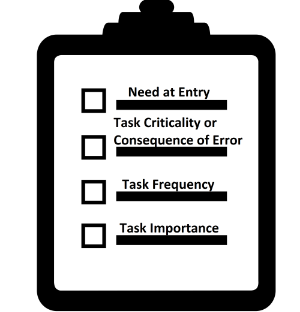
The first step in developing a credentialing exam is to conduct a job/task analysis (JTA). A job/task analysis refers to the... View Article
|
January 7, 2016 | By Corina Owens, Ph.D. |
|
|
As testing professionals, we are often communicating statistical information about items on examination forms to stakeholders involved in the examination process. This information includes a range of topics such as item difficulty and discrimination as well as simple multiple choice item option frequencies. While it is clear to those of us in the field of certification and licensure what these statistical properties mean, they can be less clear to those stakeholders who only encounter them during an exam committee meeting or even a board meeting. It is our responsibility as testing professionals to demystify these numbers and provide a meaningful discussion on the relevance and importance of the data examinations yield.
|
December 23, 2015 | By Professional Testing |
|
|
From our Professional Testing family to yours, we wish you the happiest of holidays and a Happy New Year! Check... View Article
|
December 20, 2015 | By Vincent Lima |
|
|
It's one of the most basic questions in planning and maintaining an examination program: How many items do we need to write, review, and pretest? Write too many, and you’re expending resources on inventory that will go stale. Write too few, and you can’t assemble the requisite number of test forms to your specifications. Getting Started
To answer the question, you need to review the rules you have established for yourself – your set of constraints.
|
December 17, 2015 | By Professional Testing |
|
|
Professional Testing is thrilled to be presenting at several sessions at the upcoming Innovations in Testing conference, March 20–23, 2016, in Orlando.
|
December 11, 2015 | By Vincent Lima |
|
|
In licensing and certification tests, brevity is considered a virtue. Here’s the stem of a raw item that lacks this virtue. The driver of a midsized sedan is pleased with the number of miles per gallon of gasoline the car consumes in highway conditions, but is unhappy with the amount of gasoline consumed in city driving. After changing the car’s oil and checking the tire pressure, the driver decides to look at the octane rating of the gasoline. Which of the following grades of gasoline is likely to provide the driver with the most economical gasoline use in city driving conditions?
|
December 9, 2015 | By Joy Matthews-López, Ph.D. |
|
|
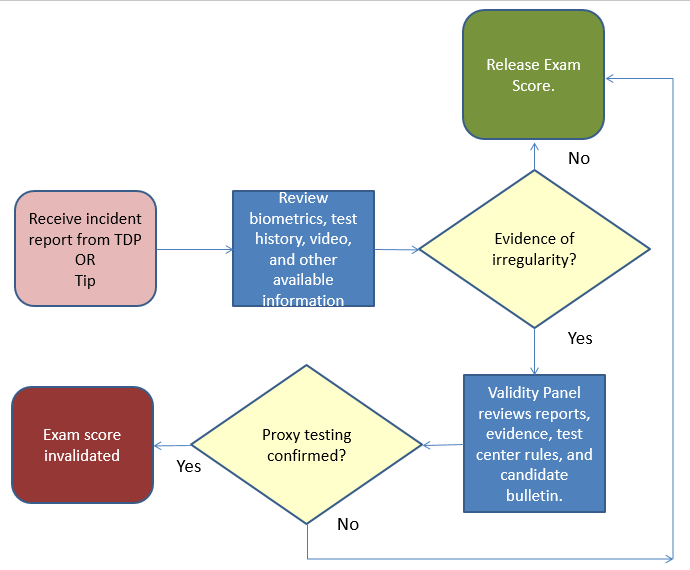
A test security flowchart is a visual protocol that is used to process anomalous (or aberrant) response vectors or incidents, and to do so in a consistent, controlled, unbiased way that contributes to the due diligence of assuring the integrity of resulting scores. By creating a flowchart for each recognized threat to a given program, anomalous or aberrant results can be processed consistently and fairly.
|
|
|
|